Understanding & Writing Business Plans & Proposals
Intended learning outcomes of this tutorial. You should be able to:
- identify and explain a possible organisational structure for a business plan
- identify and explain a possible organisational structure for a business proposal
Identifying Important Features of Business Plans & Proposals
Before we look at any of the formal properties business plans & proposals, go through the table below and think about whether, given your current knowledge, you can identify at least some of their features.
While doing the above task, you’ll probably have realised that, although you may have heard the two terms before, you may not have a full understanding of what the similarities and differences between them are. To clarify these, we’ll take a closer look at both types of documents now. We’ll begin our discussion with a brief introduction to business plans and will cover proposals later on this page.
Business Plans
Audience and Purpose
Usually, business plans are written to obtain funding and/or support for starting a new company/organisation/initiative or expanding/changing an existing one. As they represent requests for financial or other types of support, they tend to be unsolicited, i.e. not based on an invitation for submission by another party. The target audience for business plans are usually banks or other sponsors, as well as potentially other contributors, to a company/organisation/initiative. A business plan is thus a type of persuasive document, which not only seeks to report the relevant facts, but also to convince outside parties that the proposed enterprise is worth funding or supporting in some form.
As a business plan sets out the intentions of the people who want to start or expand a business/enterprise, its language is characterised primarily by descriptions of the present situation/state of planning, what may be possible to achieve in the future, or what writers hope to achieve.
Structure of a Business Plan
A business plan is usually divided into a number of different sections:
- Title page
- Table of contents (TOC)
- Executive summary
- Main body
- Profile of the company/enterprise: members, qualifications, (prior) experience, management structure, assets, etc.
- Context of the enterprise: e.g. market situation/background to the project, potential competitors/issues to be resolved, profitability/intended effects/mission statement, proposed strategies, etc.
- Financial Analysis: costs, envisaged profits, potential risks, etc.
- Appendices (optional)
The Executive Summary
The executive summary provides a very brief overview of the whole enterprise, detailing the concepts behind the enterprise, its ‘timeliness’ or appropriacy, the key people involved in it, the proposed ‘product’ or outcome, as well as the funding/support required.
Below is a short sample summary of a small software company requesting funding from a bank.
Executive Summary
Unisoft, a new startup software company, is seeking funding for establishing itself as a provider of reliable, low-cost software for classroom use in universities and schools.
Teaching software is often either very expensive or, if freeware exists, this tends to be too difficult to handle for teachers with little IT experience. What is thus required is a new type of software that allows teachers to rapidly build new teaching materials that contain interactive exercises and assessment methods that can be tailored towards different courses and subject areas. As there are literally thousands of schools and universities around the country, providing such software has extremely great potential and marketability, so that profits can be substantial even if our products are offered at relatively low cost. In order to ascertain the viability of this enterprise, we have already been in touch with a number of secondary and tertiary educational institutions throughout the area who have expressed a great interest in our products.
The proposed company will initially consist of three recent graduates of the Computer Science Department of XYZ University, as well as two linguists who graduated from the Modern Languages Department, one graduate from the School of Environmental Sciences, as well as two specialists in marketing and accounting who will handle the company finances and support the development of business teaching applications. The initial staffing arrangements will already allow us to cater for producing software for a variety of different subject areas. If successful, though, we hope to be expanding within a year by taking on board further team members that can cover additional disciplines.
In order to cover the startup costs for renting appropriate premises, buying the necessary equipment, setting up an appropriate network infrastructure, as well as to cater for initial staffing costs, we would hereby like to apply for a loan of 1 million Yuan from your bank. We expect that the company can start selling its products within half a year, and to recover the initial costs, including interest, within 2 years from setting up the company at the latest.
Read through the sample plan above and try to identify the main points of argumentation. Once you’ve finished, try to use similar strategies to write an executive summary for an NGO (non-government organisation) that promotes welfare for orphaned children in underdeveloped areas around the world and wants to gain support from the general community by recruiting members who donate a small amount of money every month. Your team should pretend to be the executive members of the NGO, with your team leader being the manager, and the other team members assuming various roles, with different types and degrees of experience, in the organisation.
As you go on writing in the box above, you should always bear in mind that it’s really only a summary that you’re producing, and therefore it ought to cover all the relevant points in as few words as possible. If you make it too long, it will actually lose some of its usefulness. In order to help you verify whether what you’ve written is getting too long, you can use the word count feature that I’ve added below, where clicking the button will check how many words you’ve put in the text box above. As a general rule, the closer you get to 400 words, the more likely it is that you’ll need to shorten your summary.
The Title Page
The title page of a business plan can be very simple, but should at least include the document category, the name of your business/organisation, information about the addressee, information about the sender, as well as the date. Below is a simulated title page for the business proposed in the executive summary above.
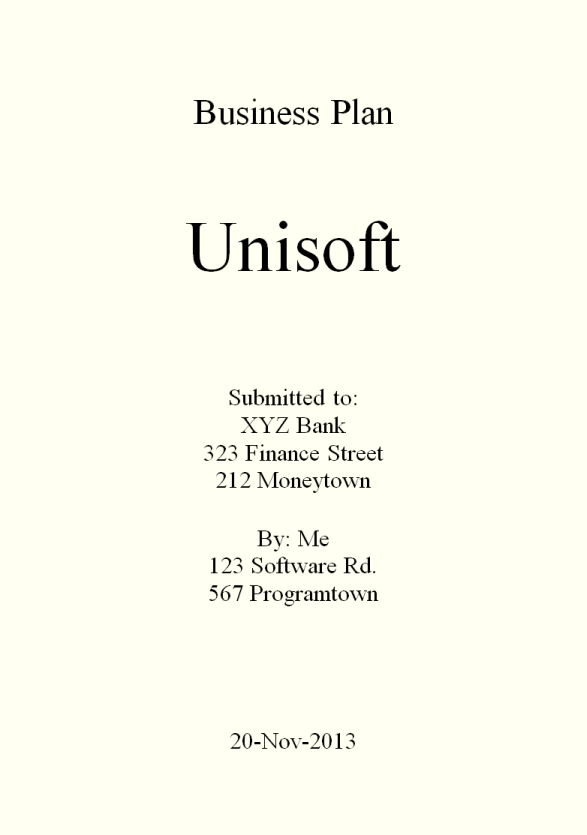
The Table of Contents
The table of contents (or TOC, for short) follows the title page and directly precedes the main body of text. It provides a very quick overview of the structure of your document and allows the reader to quickly navigate to whatever section they may be interested in. We’ll look at more extensive TOCs in a later section, so for now, let’s just take a brief look at another simple example.
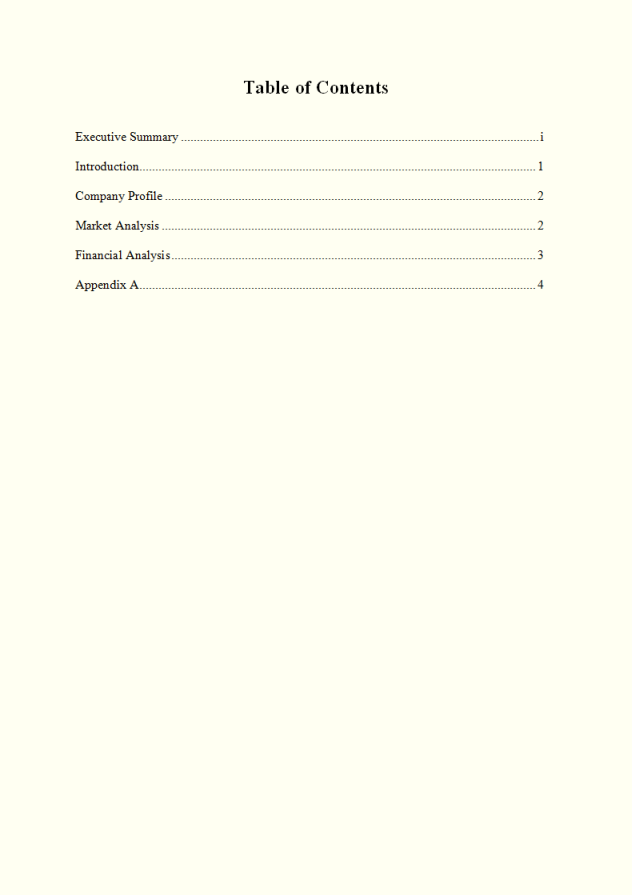
The Main Body
The main body expands on everything that has been stated in the executive summary, and provides further details regarding the organisation, its plans and ideas, the current market/background situation, as well as detailed budgeting information. A sample for main body for the above project is provided below. This includes a brief Introduction, followed by the Company Profile, a Market Analysis, as well as a Financial Analysis section.Introduction
Unisoft, a new startup software company, is seeking funding for establishing itself on the educational software market. The primary aim is to provide reliable, low-cost software for classroom use in universities, primary, and secondary schools throughout the province. Furthermore, we hope to offer ongoing support to our clients as required. The idea for this business was originally developed by Mr. X and Ms. Y when, during their final-year BA project, they observed that many classes at XYZ University made little, or only very rudimentary use of educational technology, due to the inexperience of most teachers in using IT effectively.
Company Profile
The proposed company will initially consist of three recent graduates of the Computer Science Department of XYZ University, two of which designed the original plan. To ensure that the language and subject content for the diverse types of course materials we are planning to offer and support are guaranteed, this team will be complemented by two linguists who graduated from the Modern Languages Department, and one graduate from the School of Environmental Sciences. In addition, two specialists in marketing and accounting, also recent graduates from XYZ University, will handle the company finances and support the development of business teaching applications. The initial staffing arrangements will already allow us to produce, and ensure the quality of, software for a variety of different subject areas, such as Computer Science, English, French, German, Business Studies, Environmental Sciences, Biology, Chemistry, etc., but coverage of further subject areas is already in planning.
Market Analysis
Most teaching software, such as XXX Teach, is generally prohibitively expensive, usually running into tens of thousands per classroom, and hundreds of thousands per campus licence. Therefore, most types of applications are not within the budget of many schools and university departments. Some freeware platforms for educational content delivery, such as Moodle, etc., exist, but these tend to be too difficult to set up and handle for teachers with little or no IT experience. Furthermore, they often require access to and knowledge of how to securely configure dedicated servers, a service that, again, most schools or departments are unable to offer, and which we can provide for a low monthly fee of 10,000 Yuan per year/department. What is thus required is a new type of software that allows teachers to rapidly build new teaching materials that contain interactive exercises and assessment methods that can be tailored towards different courses and subject areas, as well as facilities that make it easy to upload such content in a manner that can easily be learnt by teachers with little computing experience.
As there are literally thousands of schools and universities around the country, providing such software has extremely great potential and marketability, so that profits can be substantial even if our products will be offered at the relatively low cost of a campus/school licence for 50,00 Yuan for a medium-sized school and 100,000 Yuan for a university.
The basic design of our software is based on a teaching platform created within the framework of the final-year project of the two founders of the company, which was awarded a distinction and received the first prize amongst all final-year projects in the Computer Science Department at XYZ University in 2012. As part of the project, the prototype for this platform has already been tested in a number of different departments around XYZ, and received wide approval, due to its speed and ease of use.
In order to ascertain the commercial viability of this enterprise, we have already been in touch with a number of secondary and tertiary educational institutions throughout the area, who have expressed a great interest in our products after having seen our prototype in action. For more information, see the detailed list of interested institutions and departments in Appendix A. If successful, we also hope to be expanding within a year by taking on board further team members that can cover additional disciplines.
Financial Analysis
In order to cover the startup costs for renting appropriate premises, buying the necessary equipment, setting up an appropriate network infrastructure, as well as to cater for initial staffing costs, we would hereby like to apply for a loan of 1 million Yuan from your bank.
The initial costs are broken down into two tables below, one including one-off expenses, the other monthly ones:
| Item | Cost |
|---|---|
| Equipment purchases | 300,000 |
| Network setup | 50,000 |
| Total | 350,000 |
| Item | Cost |
|---|---|
| Staffing | 48,000 |
| Rental & maintenance of premises | 15,000 |
| Running costs (electricity, etc.) | 30,000 |
| Total | 93,000 |
We expect that the company can start selling its products within 3 months, and to recover the initial costs, including interest, within 2 years from setting up the company at the latest.
Before we’ll discuss business proposals, which frequently tend to be more formal in nature, especially if solicited, we’ll first take a look at how longer, more formal documents are generally structured.
Elements of Formal Documents
The formal document, just like a book, can be divided into three consecutive main sections:
| front matter | body of the document | back matter. |
Essentially, the front matter contains everything up to the beginning of the main text (body), and the back matter everything that follows it. Both front and back matter essentially contain meta-information, i.e. information about the main text, rather than constituting the main text itself. We’ll discuss the individual parts of the front and back matter, as well as the purposes behind them, in the following subsections.
The Front Matter
The front matter usually consists of a title page, table of contents, list of figures, list of tables, and may also contain an executive summary.
The Title Page
Unless the document is accompanied by a transmittal letter or other form of memo, the title page provides the first point of contact of the reader with the document. It therefore needs to provide all the most important information about the document at a single glance, and make it possible to identify what its purpose and approximate content are, who is responsible for creating it, how up-to-date it is, etc. The exact format for the title page for a formal document may of course vary according to the exact purpose or target audience. However, it should normally include the following information:
- the full title of the document,
- the document date,
- the name(s) and job title(s) of the writer, group or department,
- the name of the organisation for which the writer(s) work(s),
- the name of the organisation or person to which the document is submitted.
Below, you can look at a number of different title pages to get a feel for what they may look like.
Try to identify the different elements of the title pages above. What is the variation between the different samples ? Do they all have the elements as described above? Why do you think there is such variation?
The Table of Contents (TOC)
A table of contents lists all the headings (down to a certain level, usually 2 or 3) of the document in their order of appearance, along with their page numbers. It includes a listing of all front matter and back matter of the document, except for the title page and the table of contents itself.
Formal documents target different audiences. When a formal document is read by your supervisor, he or she will have different interest from a technician reading the same document. As such, not every reader needs to/will necessarily have to read every section of your document. Furthermore, even readers who read the whole document may sometimes need to return to particular sections. This is why a table of contents represents an important navigational aid to the reader. In addition to this, and perhaps even more importantly, a TOC represents the overall logic of the organisation of your document, i.e. illustrates how you have chosen to break up your approach into manageable sub-parts. Of course, there may sometimes be only a limited degree of flexibility in this, particularly if the structure of your document is relatively fixed by convention. However, this conventional structure mainly reflects the top-level headings, and you will generally still have a certain degree of flexibility below that level. Exploiting this flexibility will allow you to demonstrate to the reader that you’ve understood the nature of your project well, so you should try to use explicit and precise sub-headings to ‘impress’, or rather convince, your audience of your in-depth understanding.
Below are a few samples of the table of contents.
How are the organisations of the above table of contents different from each other? Think in terms of the layout, as well as the information included. How are the front matter and back matter presented?
The table of contents is placed directly after the title page and before all other elements. It can, and should be, generated automatically using modern word processors. If you are using Microsoft® Word, in order to let the word processor know what to include in the table of contents, you first need to include proper headings and subheadings and apply the appropriate heading styles (Heading1, Heading2, ...) to them. Once you have your document with the correct hierarchy of headings, you can have the program generate a table of contents for you automatically via ‘References→Table of Contents’ in the latest version (2010). Other word processors provide similar features, but you need to consult their user manuals for details.
Lists of Figures/Tables
When a document contains more than five figures, list them along with their titles and page numbers in a separate section beginning on a new page. Figures include all illustrations – i.e. drawings, photographs, maps, charts, and graphs – contained in the document. This page, and any other page before the main document itself, should be numbered with small Roman numerals (e.g. i, ii, iii, ...). Anything that forms part of the main body should then be numbered with Arabic numerals (e.g. 1, 2, 3, ...). If you’ve inserted their captions through the ‘Insert Caption’ feature provided by your word-processor, this will also allow you to generate tables of tables and tables of figures automatically.
When a document contains more than five tables, list them along with their titles and page numbers in a separate section beginning on a new page. This page should also be numbered with a small Roman numeral.
Look at sample two of the Table of Contents above. How are the Lists of Figures/Tables presented? Is the style different from the one we have talked about just now? How can it be improved?
The Back Matter
The back matter of a formal document contains supplementary information, such as identification of the cited works (references), and more detailed, additional reference materials in the form of one or more appendices.
References
The ‘References’ section is an alphabetical (APA) or numerical (IEEE) listing of all the published sources you’ve consulted and cited in preparing your document. You need to have (precise) references to prove to the reader that your information and materials are i) genuine and ii) have not been invented by you.
Appendix (Appendices)
An appendix contains information that clarifies or supplements text. Materials placed in the appendix are typically long tables, charts, graphs, sample copies of questionnaires, pamphlets brochures, etc. The document may have one or more appendices. Generally, each appendix contains one type of material. For example, a report may have one appendix presenting a questionnaire and a second appendix presenting a detailed computer print-out tabulating questionnaire results.
Place the first appendix on a new page directly after the references. Each additional appendix also begins a new page. Identify each appendix with a title and a heading. Appendices are generally labelled Appendix A, Appendix B, etc.
Now that you know more about the structure, front, and back matter of longer (formal) documents, we can turn our attention to the contents of business proposals.
Business Proposals
Audience and Purpose
In contrast to business plans, which are produced and sent at the initiative of individuals who want to obtain support, business proposals can either be solicited or unsolicited, as they represent suggestions for a certain course of action to be taken. This may happen either within an organisation, or be directed at an outside organisation.
If such proposals are unsolicited, they may be based on the initiative of a member of the organisation who has identified a weakness or problem in the way the organisation is conducting its business, and wants to suggest a way of resolving this issue. If solicited, they could either be responding to an informal request by someone within your organisation (e.g. the boss or team/project leader, etc.), or to a formal Request for Proposals issued by an outside organisation.
The Request for Proposals (RFP)
The RFP is a document issued by an organisation that wants to commission another organisation to carry out a project on its behalf. It generally provides some background on the commissioning institution, explains the nature of the proposed project, possibly a timeline, which services or qualifications the company that bids for the proposal is assumed to provide, potentially how any bid is going to be evaluated (in terms of priorities), as well as who to contact for further information or to submit a bid within the commissioning institution. Below is a very brief example of a possible RFP that’s loosely related to the above business plan.
ABC International School
25, ABC Road
ABC Town
29-Nov-2013
To whom it may concern,
ABC International School is inviting proposals for a new, easy-to-use teaching software platform to be employed throughout our school from the next semester onwards. The ideal solution would also include ongoing support and training for our staff on a quarterly basis or whenever required at short notice. If you feel that your company can offer this service at a reasonable cost, please submit a proposal to us no later than 15-Dec-2013. The following provides a brief description of the school, its current IT infrastructure, and the services we would expect you to provide if your company should be commissioned by us.
Background of our Institution
ABC International School is a medium-sized international school in Y Province, its teaching staff currently comprising some 50 teachers who teach approximately 630 students. We have 35 classrooms, all equipped with PCs running the YYY operating system, with internet connection, using Mozilla Firefox as a browser, and a variety of Office and other, predominantly open-source or free, software installed.
Expected Services
Your company would be expected to provide a teaching and learning platform that is easy to use even for our less IT-literate teachers, highly extensible and customisable for the different subjects taught. In addition, as already pointed out above, we will require regular support and training sessions for new members of staff, as well as occasional refresher courses for existing members, or even specialised one-off training sessions arranged at relatively short notice. The teaching platform should integrate well into our existing IT infrastructure, and not force us to acquire new and expensive additional software.
Contacts
To submit your proposal or request further information, please contact our IT coordinator, Ms N N, on +86-12345678910 or via email at n.n@abc_school.org.
Yours sincerely,
Dr X Y
Headmaster of ABC International School
More detailed RFPs can also contain more elaborate instructions as to how exactly the invited organisation should respond, as well as information concerning the way the proposal will be evaluated. Of course, though, the more constrained or restrictive the RFP is, the less flexibility the responding party may have to develop more appropriate and creative ideas than the ones originally developed by the requestor.
To learn to understand better how RFPs need to be structured, and what they ought to contain, write a brief one for your own scenario in the text box below.
Structure of a Business Proposal
Just like a business plan, a (formal) business proposal is usually divided into a number of different sections:
- Letter of Transmittal (‘Cover Letter’)
- Copy of RFP (if applicable)
- Title page
- Table of contents (TOC)
- List of Illustrations
- Executive summary (optional)
- Introduction
- Body
- Conclusion
- Appendices (optional)
As you can see, many of the parts of a business proposal are very similar to the general parts included in longer documents, so we here only need to discuss issues in writing such proposals that you need to pay particular attention to.
If the proposal is responding to an RFP, then the Letter of Transmittal obviously needs to be make extensive reference to this in some detail. This should be done by first referring to the invitation to submit a proposal, for instance when the invitation was received, the deadline for submissions for proposals, etc., as well as a summary of how specifically the most important points in the RFP have been addressed in your proposal. If there is no formal RFP, then you need to describe your motivation or other reasons for submitting the proposal.
If you’re responding to an RFP, you should also attach a copy of it to your proposal. Sometimes, larger companies may be sending out RFPs for a number of different projects, and then it will be easier for the receiver to identify which project your proposal is meant to address. Furthermore, attaching the RFP also clearly indicates that your proposal was solicited.
The title page can be similar to the ones we’ve seen above, but may also be a little more elaborate, e.g. incorporating a company logo, etc. You should definitely indicate on it that your document is a proposal, what exactly the proposal is for, who it’s addressed to, as well as who’s sending it.
Essentially, if your cover letter already summarises and emphasises the main points of the proposal clearly, the Executive summary is somewhat redundant and may be omitted.
The main text is subdivided into the three sections Introduction, the main body of text, with any headings & content that may be relevant to your proposal here, and a Conclusion section. The Introduction basically provides the background information to the proposal, again making reference to the RFP, if applicable, or anything else that may have motivated you to write the proposal. The main body needs to adress how you’re planning to carry out the project (including necessary resources & approximate timeline), any type of analysis or assessment of the scenario you may have done, as well as the budget required. Here, you need to try your best to demonstrate to the other party that you/your company are the best choice for the job at hand, providing all the necessary facts and arguments, and exhibiting all the relevant know-how. In the Conclusion, you need to summarise all the main arguments again, and make a final attempt to convince the addressee of your suitability for the project.